How Much Does Crypto Arbitrage Bot Development Cost?
Trading Systems Architect
12 min read
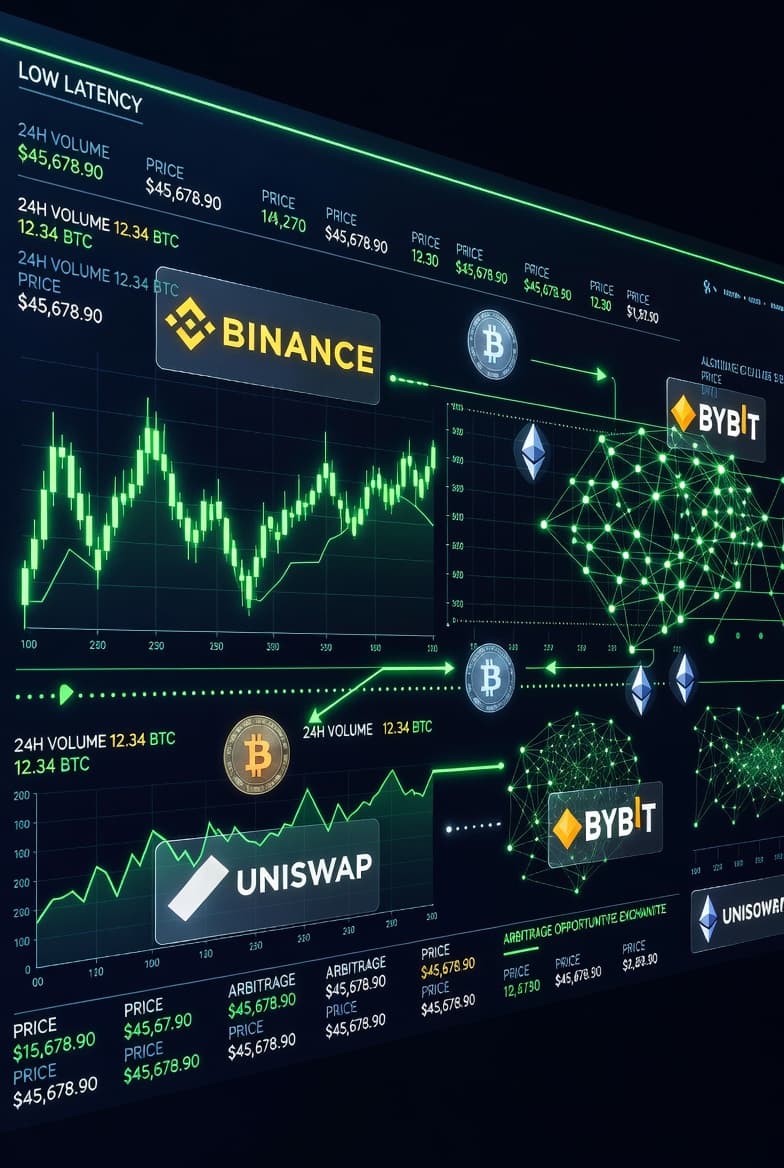
How Much Does It Cost to Build a Crypto Arbitrage Trading Bot in 2026? – Detailed SEO Guide
The crypto arbitrage bot development cost in 2026 remains one of the most searched topics among traders, developers, and crypto startups looking to automate profitable price difference strategies across centralized exchanges (CEX), decentralized exchanges (DEX), and cross-chain bridges. With market fragmentation increasing due to new Layer-2 solutions, perpetual futures platforms, and regional exchanges, arbitrage opportunities are more abundant than ever — but so are the technical challenges.
Building a reliable crypto arbitrage trading bot requires balancing low-latency execution, robust error handling, real-time data feeds, anti-front-running protection, MEV resistance, and regulatory compliance features. Whether you're targeting simple triangular arbitrage, statistical arbitrage, funding rate arbitrage, or advanced cross-chain flash-loan arbitrage, development costs vary widely depending on speed requirements, exchange coverage, AI/ML prediction layers, and institutional-grade security.
This comprehensive 2026 guide answers the high-intent search queries “how much does a crypto arbitrage bot cost”, “crypto arbitrage bot development cost 2026”, “arbitrage trading bot price”, and “cost to build crypto trading bot” with real numbers, timelines, hidden expenses, and actionable advice. We also explain how professional crypto arbitrage bot development services from BitGoLabs can help you launch faster, rank higher on Google, and stay profitable in competitive markets.
By the end of this article, you'll understand exactly what drives crypto bot pricing, how to avoid common cost overruns, and which features deliver the best ROI for arbitrage strategies in today's multi-chain environment.
Crypto Arbitrage Bot Development Cost in 2026 – Full Breakdown
The average crypto arbitrage bot development cost in 2026 ranges from $8,000 for a minimal viable product (MVP) to $400,00+ for enterprise-grade systems with AI signal prediction, multi-chain support, and institutional security. These numbers reflect real projects completed in 2025–2026 and account for inflation in developer rates, cloud infrastructure, and security audit pricing.
Detailed Cost Ranges by Bot Complexity Level
- Basic Arbitrage Bot (single exchange, simple price monitoring): $10,000 – $25,000
- Intermediate Cross-Exchange Bot (Binance, Bybit, KuCoin, Uniswap v3, arbitrage between CEX/DEX): $5,000 – $25,000
- Advanced HFT Arbitrage Bot (sub-50ms latency, AI/ML opportunity detection, MEV protection, flash-loan integration): $70,00 – $40,000+
- Enterprise / Institutional Grade (multi-region deployment, compliance reporting, cold wallet integration, formal verification): $10,000 – $30,000+
What Drives the Crypto Arbitrage Bot Development Cost in 2026?
Several technical and business factors significantly influence the final arbitrage trading bot price:
- Latency & Execution Speed: Dedicated low-latency servers, WebSocket optimization, and co-location near exchange data centers can add $7,000–$35,000.
- Exchange & Chain Coverage: Each additional exchange API integration (with rate-limit handling, error recovery, nonce management) costs $3,000–$8,000 per exchange.
- AI/ML Prediction Layer: Training models to predict arbitrage windows before they appear increases cost by $6,000–$40,000 but dramatically improves profitability.
- Security Architecture: End-to-end encryption, API key vaulting, anti-front-running logic, DDoS protection, and third-party audits add $7,000–$35,000.
- Backtesting & Simulation Engine: Historical data pipeline + Monte Carlo simulation tools: $5,000–$25,000.
- Cloud & Infrastructure: AWS Graviton / Google Cloud low-latency instances, Redis caching, Kafka for event streaming: $200–$2,500/month ongoing.
- Smart Contract Interaction (for DEX/flash-loan arbitrage): Solidity development + gas optimization + formal verification: $7,000–$35,000.
Realistic Development Timeline for Crypto Arbitrage Bots
- MVP (proof-of-concept, 1–2 exchanges): 8–14 weeks
- Production-ready intermediate bot: 16–24 weeks
- Advanced AI-powered HFT system: 6–12 months
- Enterprise deployment with compliance: 9–18 months
Hidden & Recurring Costs Most People Ignore
- Low-latency VPS / dedicated servers: $300–$2,500/month
- Market data feeds (Kaiko, CoinAPI, Nomics): $500–$5,000/month
- Third-party security audits (Certik, PeckShield, Quantstamp): $6,000–$40,000 per audit
- Ongoing maintenance & strategy tuning: $1,500–$6,000/month
- Legal & compliance consulting (for institutional clients): $5,000–$45,000
How to Reduce Crypto Arbitrage Bot Cost Without Losing Quality
Use open-source libraries (CCXT, Hummingbot base), start with MVP, outsource to high-skill regions (India/Eastern Europe), leverage pre-audited smart contract templates, and partner with experienced teams offering crypto arbitrage bot development services.
Why 2026 Is the Best Time to Build an Arbitrage Bot
Increased Layer-2 adoption, perpetual contract funding rate disparities, new DEX aggregators, and regional price fragmentation create more arbitrage windows than ever. A well-built bot can pay for itself in weeks or months.
Final Thoughts – Get Your Custom Quote Today
The crypto arbitrage bot development cost in 2026 is an investment — not an expense — when executed correctly. Focus on security, speed, and adaptability to stay ahead of competitors.
Ready to build or optimize your arbitrage bot? Contact BitGoLabs for a tailored quote on crypto arbitrage bot development services — secure, scalable, and built to win in 2026 markets.
Sources and Further Reading
Explore related services: Blockchain Development, Security Audits, and Web3 Wallet Infrastructure.
Decentralized infrastructure is the new paradigm for global assets. BitGoLabs architects the bridge to this future.
Knowledge Base
Frequently Asked Questions
Clear answers to common questions about blockchain, trading infrastructure, and digital asset platforms.
Which blockchain is best for launching a token?
+
Ethereum and Base offer institutional liquidity and ecosystem depth, while BNB Chain and Solana provide lower fees and high retail participation. The optimal choice depends on your audience, funding strategy, and long-term utility.
Can existing VR headsets access your Metaverse solutions?
+
Yes. Our environments are optimized for Quest 3, Apple Vision Pro, and Valve Index, as well as standard browser-based access.
How scalable are crypto payment systems?
+
Layer-2 networks, batching, and gas optimization allow Web3 payment infrastructure to support millions of users and high-frequency transactions.
How much does blockchain development cost?
+
Blockchain development cost depends on architecture complexity, smart contract scope, security requirements, and infrastructure scale. It typically ranges from $6000 to $39999+, with simple decentralized applications starting lower and enterprise-grade Layer-1 or Layer-2 blockchain ecosystems requiring higher investment. BitgoLabs provides transparent cost estimation aligned with long-term scalability and ROI.
Can crypto payments be converted instantly to fiat?
+
Yes. Integrated on-ramp and off-ramp providers enable real-time conversion, allowing merchants to avoid volatility while accepting global crypto payments.
Infrastructure Brief
Initiate Protocol Design
Connect with BitGoLabs architects to engineer institutional-grade blockchain, trading, and tokenization systems.
Related
Recommended Insights

AI Security & Governance 2026-Blockchain-Protected AI Systems
Explore AI security, blockchain verification, and decentralized governance in 2026 to protect AI systems, ensure trust, and prevent manipulation.

Cost to Build a Tokenization Platform 2026-Pricing & Timeline
Explore the complete cost breakdown, development timeline, features, and smart contract infrastructure for building a tokenization platform in 2026.

How Much Does Decentralized Identity Development Cost?
2026 decentralized identity (DID/SSI) development cost - self-sovereign identity, zero-knowledge proofs, verifiable credentials, blockchain integration – full pricing guide.