How Binary Crypto Prediction Games Work: Rounds, Oracles & Payouts
Product Manager
8 min read
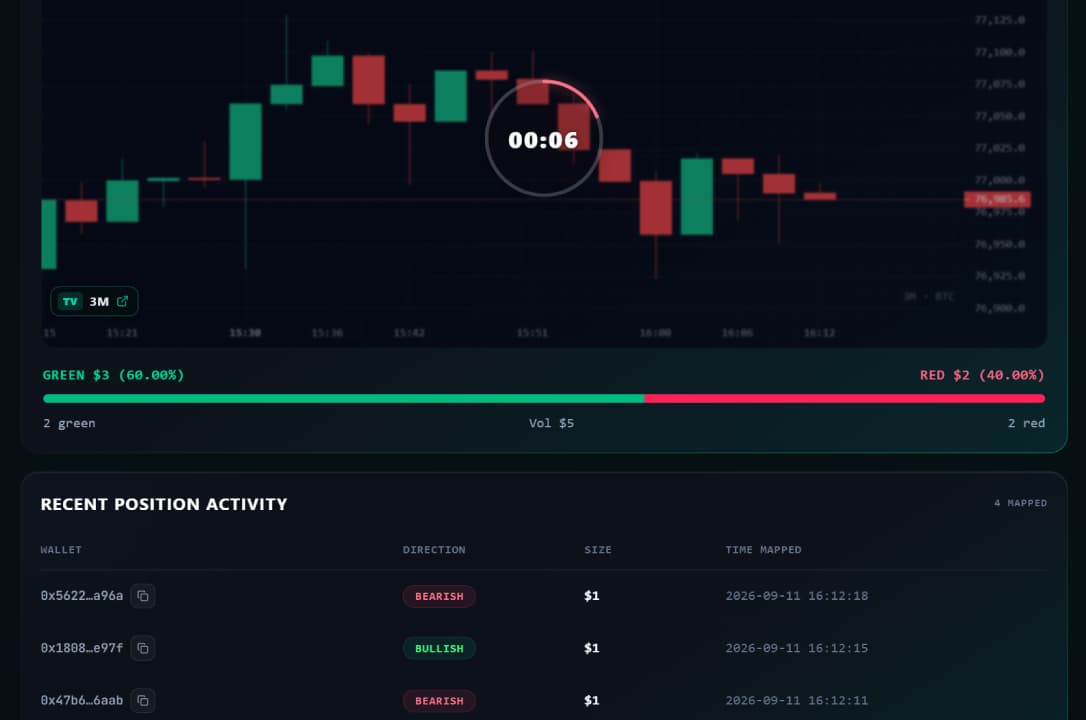
How a Binary Crypto Prediction Game Works
In a binary crypto prediction game, users predict whether an asset's price will be higher or lower at the end of a short round, for example five minutes. The mechanics look simple, but fairness depends on exact rules about when a round locks, which price counts, and how payouts are calculated. This guide walks through each part.
To build one, see our prediction game development services.
The Round Lifecycle
- Open: users place predictions (up or down) with a stake.
- Lock: at a fixed time the round closes to new predictions and the lock price is recorded from the oracle.
- Live: the round runs until its end time.
- Settle: the end price is recorded, the winning side is determined, and payouts are calculated.
- Claim or credit: winners claim on-chain or receive a ledger credit, depending on architecture.
Where the Price Comes From: Oracles
Fair games need a price source that neither the operator nor the players can manipulate. Decentralized oracle networks such as Chainlink and Pyth publish signed price data, and a game contract can read the price at lock and settle time. A clearly documented rule, such as which feed, which timestamp and what happens on a stale price, removes room for disputes.
Pool-Based Payout Math
In a pool (parimutuel) design, winners share the losers' stakes minus a platform fee. If the total pool is T, the winning side's total stake is W, and the fee is f, then a winner who staked s receives:
payout = (s / W) × T × (1 − f)
Example: the up side staked 600, the down side staked 400, so T = 1,000. If up wins with a 3% fee, an "up" player who staked 100 receives (100 / 600) × 1,000 × 0.97 ≈ 161.7. If one side has no stakes, the round should refund players, a rule that must be coded and tested explicitly.
Fixed-odds designs instead quote a payout up front, so the platform carries the risk and needs liquidity and exposure limits.
What Makes a Prediction Game Provably Fair
- Round times and rules are fixed and published before play
- Prices come from a verifiable oracle, with the feed and timestamps recorded
- Settlement logic is deterministic and, for on-chain games, open-source and audited
- Tie and stale-price handling are defined in advance
- Round history is auditable by players
Custodial vs Non-Custodial
| Aspect | Custodial | Non-custodial (on-chain) |
|---|---|---|
| Funds held by | Platform ledger | Smart contract |
| Speed and UX | Fast, no gas per action | Depends on chain and gas |
| Trust model | Players trust the operator | Players can verify the code |
| Main engineering effort | Ledger, wallets, fraud controls | Contracts, oracle integration, audit |
Main Risks to Design For
- Oracle manipulation or staleness: use reputable feeds and reject stale data
- Last-second entry: enforce lock times on the server and contract, not the client
- Smart contract bugs: audit before holding user funds
- Regulation: prediction and betting products are regulated in many countries; take legal advice, and add age and geo checks
Frequently Asked Questions
How do binary prediction games decide the winner?
They compare the oracle price at lock time with the price at round end. Higher means the up side wins, lower means down wins, with defined handling for ties.
Can the operator rig a round?
Not if settlement uses a verifiable oracle and published rules. Custodial platforms still need transparency and audit logs.
How much does it cost to build?
See our prediction game development cost guide.
Which oracle should I use?
Chainlink and Pyth are widely used. Choose based on your chain, the assets you need and update frequency.
Ready to build? Explore BitGoLabs prediction game development or request an estimate.
Sources and Further Reading
Decentralized infrastructure is the new paradigm for global assets. BitGoLabs architects the bridge to this future.
Knowledge Base
Frequently Asked Questions
Clear answers to common questions about blockchain, trading infrastructure, and digital asset platforms.
Do you provide white-label blockchain development solutions?
+
Yes. BitGoLabs offers white-label blockchain platforms including exchange infrastructure, wallets, DeFi protocols, and tokenization engines that can be fully branded and customized for your business requirements.
Do you support secondary trading and liquidity?
+
Yes. Our platforms integrate compliant marketplaces and decentralized liquidity rails to enable controlled peer-to-peer trading of tokenized assets.
Which blockchain is best for NFT gaming?
+
High-performance networks with low fees and gaming-focused infrastructure—such as zk-based or specialized gaming chains—are typically preferred. The optimal choice depends on scale and gameplay requirements.
How long does it take to build a blockchain solution?
+
Development timelines vary based on technical scope and compliance needs. Basic smart contract or dApp solutions may take a few weeks, while custom blockchain networks, tokenization platforms, or exchange infrastructures can require several months including testing, auditing, and deployment. Our structured engineering lifecycle ensures predictable delivery without compromising security.
Are smart contracts secure?
+
Smart contracts can be highly secure when developed using audited frameworks, formal verification, and rigorous testing. Vulnerabilities typically arise from poor coding practices or missing audits. BitgoLabs follows strict security engineering standards, automated testing pipelines, and third-party audit readiness to ensure production-grade protection.
Infrastructure Brief
Initiate Protocol Design
Connect with BitGoLabs architects to engineer institutional-grade blockchain, trading, and tokenization systems.
Related
Recommended Insights
Crypto Token Development Cost: ERC-20, BEP-20 & Solana Token Guide
What it costs to create and launch a crypto token in 2026: standards, tokenomics, vesting, audits, launchpad infrastructure, timelines and common mistakes.

Top Crypto Wallet Development Companies 2026-Secure & Scalable
Explore leading crypto wallet development companies in 2026, offering secure, scalable, multi-chain solutions for Web3 and enterprise asset management.
ICO Development Strategies 2026-Tokenomics & Investor Value
Explore top ICO strategies, sustainable tokenomics, and secure infrastructure to build investor-trusted blockchain projects in 2026.