What Is AI Arbitrage? How AI Crypto Arbitrage Bots Work
BitGoLabs Trading Systems Team
9 min read
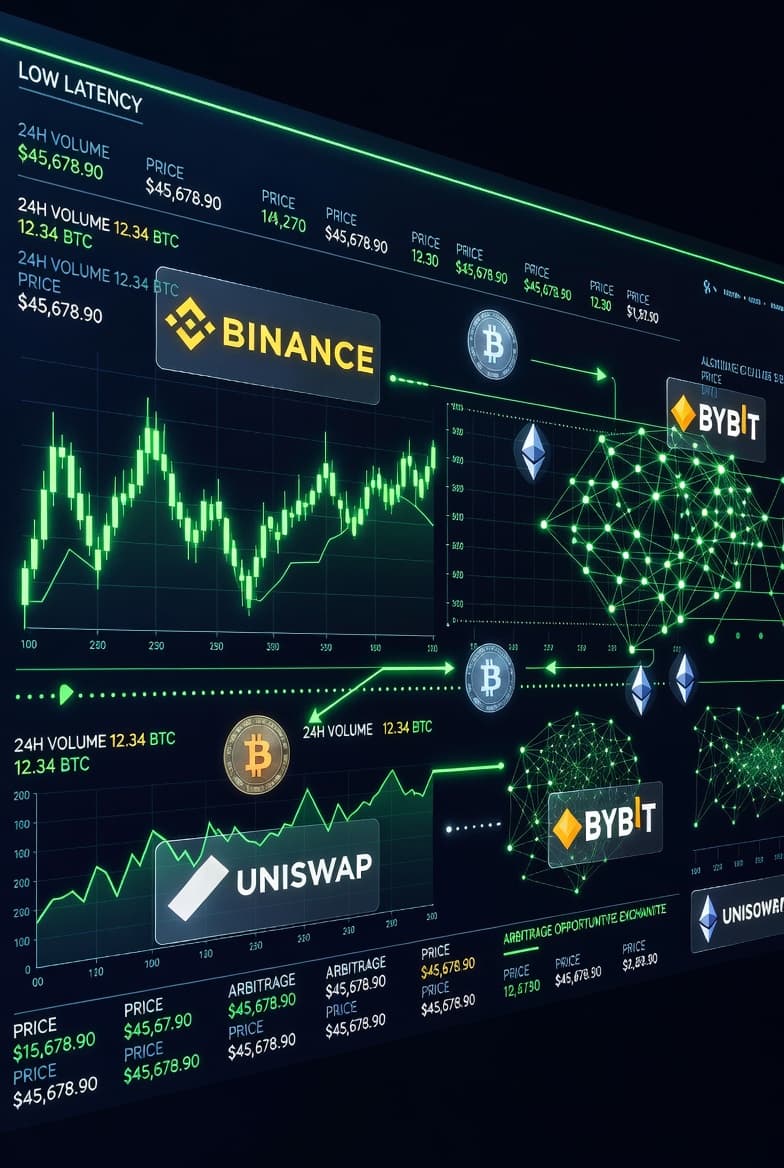
What Is AI Arbitrage?
AI arbitrage is arbitrage trading where machine learning models find, rank and time price differences between markets, instead of a human or a fixed rule doing it. The core idea is old: buy an asset where it is cheap and sell it where it is expensive. What AI adds is speed, pattern recognition and the ability to adjust as market conditions change.
In crypto, the same token often trades at slightly different prices across centralized exchanges (CEX), decentralized exchanges (DEX) and different blockchains. An AI arbitrage system watches many venues at once, estimates whether a gap will still be profitable after fees and slippage, and decides how much to trade. Trading involves risk of loss. Nothing in this guide is financial advice, and no strategy or software can guarantee profit.
How AI Arbitrage Differs From a Classic Arbitrage Bot
| Aspect | Rule-based bot | AI-assisted bot |
|---|---|---|
| Opportunity detection | Fixed spread threshold | Model scores each gap on expected net profit |
| Position sizing | Fixed or simple percentage | Adjusts to liquidity, volatility and fill probability |
| Adapting to the market | Manual tuning | Retrains or re-weights on new data |
| Failure mode | Misses new patterns | Overfits to old data if not validated |
Many production systems are hybrid: hard-coded safety rules sit around the AI layer, so a bad prediction can never exceed set limits.
Where AI Is Actually Used
- Fill prediction: estimating whether both legs of a trade will execute before the gap closes
- Slippage and fee forecasting: modelling the real net profit of a trade, not the headline spread
- Venue and route selection: choosing the best pair of exchanges or pools at that moment
- Risk limits: detecting abnormal conditions such as thin books, halted withdrawals or depegs
- Funding-rate and basis trades: ranking carry opportunities between spot and perpetual markets
The Main Types of Crypto Arbitrage
AI can be applied to any of these. For a deeper comparison, read our guide to types of crypto arbitrage bots.
- Cross-exchange (CEX to CEX) arbitrage
- CEX to DEX arbitrage
- Triangular arbitrage inside one exchange
- Cross-chain arbitrage
- Funding-rate and basis arbitrage
- Flash loan arbitrage on DEXs
Risks You Should Understand
- Competition: simple gaps are taken by faster firms, so profits shrink over time
- Execution risk: one leg of a trade may fill while the other does not
- Transfer delays: moving funds between venues takes time and can fail
- Model risk: a model that worked in testing can fail in a new market regime
- Exchange and smart contract risk: outages, API changes, withdrawal limits and contract bugs
- Regulation and tax: rules differ by country and apply to trading profits
Nobody can promise returns from arbitrage, and "AI" is not a guarantee. Treat any provider that does as a warning sign.
What It Takes to Build One
- Choose the arbitrage type and venues
- Build low-latency market data feeds and an order execution layer
- Backtest and paper-trade on realistic fees, latency and slippage
- Add the AI layer only where it beats a simple rule in testing
- Wrap everything in risk controls: position limits, kill switch, alerts
- Deploy with monitoring and review performance regularly
If you are planning a build, see our step-by-step guide to building a crypto arbitrage bot and the crypto arbitrage bot development cost breakdown, or talk to our team about custom crypto arbitrage bot development.
Frequently Asked Questions
What is AI arbitrage in simple terms?
It is arbitrage trading where AI models decide which price gaps are worth acting on, how much to trade and when, rather than relying on one fixed rule.
Is AI arbitrage profitable?
It can be, but profit is never guaranteed. Fees, slippage, competition and execution risk can remove the gap, and results depend on infrastructure, capital and risk control.
Is AI arbitrage legal?
Arbitrage trading itself is generally legal, but rules on trading, licensing and tax vary by country. Check the rules where you operate and where your exchanges are based.
Do I need AI for crypto arbitrage?
No. Many profitable setups use simple rules with fast execution. AI helps most with prediction, sizing and risk, and should be added only if it improves tested results.
What is the difference between CEX-CEX and CEX-DEX arbitrage?
CEX-CEX arbitrage trades between centralized exchanges and is limited by transfer and API speed. CEX-DEX arbitrage trades against on-chain pools and adds gas costs, slippage and MEV risk.
Sources and Further Reading
Decentralized infrastructure is the new paradigm for global assets. BitGoLabs architects the bridge to this future.
Knowledge Base
Frequently Asked Questions
Clear answers to common questions about blockchain, trading infrastructure, and digital asset platforms.
How much does futures trading bot development cost?
+
Cost varies based on exchange count, bot strategy (DCA, GRID, or both), feature set, multi-user requirements, and DEX integration complexity. As a startup-friendly team, typical production-grade systems range from $3,000 for single-exchange DCA or GRID-only bots to $8,000 for multi-exchange with advanced features, to $15,000+ for dual strategy (DCA + GRID) with DEX integration and multi-user white-label scaling. BitGoLabs provides custom quotes after technical discovery.
How much does smart contract security audit and formal verification cost?
+
Smart contract audit cost depends on lines of code, protocol complexity, chain and language, and review depth. Small token contracts start around $2,000 to $10,000, standard single-protocol audits typically run $10,000 to $50,000, and complex DeFi, bridge or multi-chain systems with fuzzing and formal verification run $50,000 to $150,000 or more. Rush audits and Solana, Move or ZK work add a premium. We scope every audit from your code and quote a price range before work starts.
Is a blockchain necessary for a Metaverse?
+
While not strictly required, blockchain enables true digital ownership, decentralized governance, and a secure internal economy that isn't controlled by a single entity.
Is RWA tokenization compliant with regulations?
+
Yes, when designed with jurisdiction-specific compliance logic, investor verification, and regulated issuance frameworks. BitgoLabs builds tokenization platforms aligned with evolving global regulatory standards.
What is the difference between Ethereum, BNB, Solana and Tron MLM software?
+
The business logic is the same; the network changes cost and speed. Ethereum and Layer-2 networks offer the strongest security record, BNB Chain and Tron offer low fees for high member counts, and Solana offers fast, cheap transactions. BitGoLabs builds smart contract MLM software on each of them and can recommend one after reviewing your plan.
Contact us
Tell us about your project
A senior engineer will reply within 24 hours with next steps and a rough estimate. The first consultation is free.
Send us a message
Fields marked with * are required.
Related
Recommended Insights

Smart Contract Audit Cost in 2026: Pricing by Chain, Scope & Audit Type
How much does a smart contract audit cost in 2026? Price ranges by protocol type and chain, premiums for Solana, Move and ZK, timelines by lines of code, audit vs contest vs bug bounty, and how to lower your bill.

How Much Does Copy Trading Platform Development Cost?
2026 copy trading platform cost: social trading, strategy mirroring, risk controls, security & multi-asset support – MVP to enterprise pricing breakdown.

NFT MLM Software Development: How It Works & Risks
NFT MLM software ties network rewards to NFT memberships or products. Learn how it works, how to design it responsibly, and the legal and security risks.