NFT MLM Software Development: How It Works & Risks
BitGoLabs Smart Contract Team
7 min read
What Is NFT MLM Software?
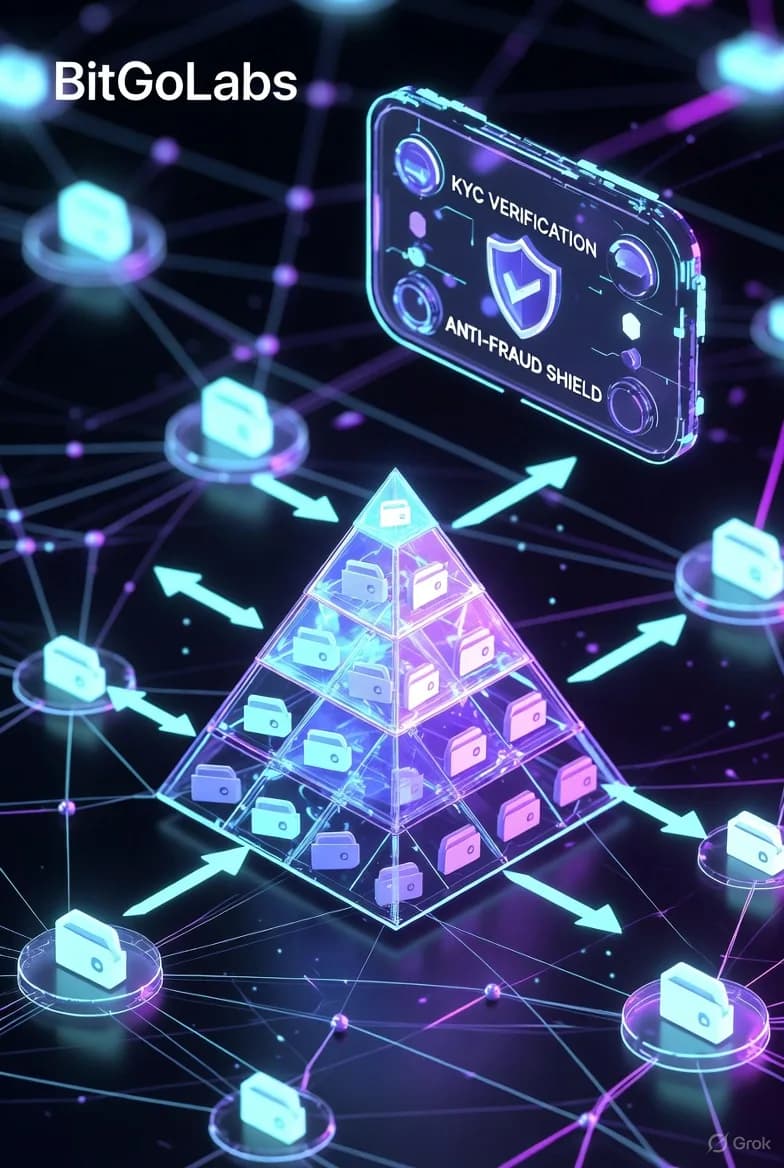
NFT MLM software is a network marketing platform where memberships, ranks or products are NFTs, and rewards are paid by smart contracts when those NFTs are bought or sold. The NFT can be a membership pass, a digital product, a collectible or an access key.
It adds ownership and resale to the usual MLM model, but it also adds legal and design risk, which this guide covers.
How an NFT-Based Network Works
- A member buys an NFT membership or product through the platform contract.
- The contract pays referral and level rewards to sponsors in the same transaction.
- The NFT unlocks something real: software access, content, events or discounts.
- Members can resell the NFT on a marketplace, with an optional creator royalty.
- A dashboard shows tree, rewards and NFT holdings from on-chain data.
Design Choices
| Decision | Options | Consideration |
|---|---|---|
| NFT standard | ERC-721 (unique) or ERC-1155 (tiers and copies) | ERC-1155 suits many members at the same tier |
| Utility | Product access, service credits, discounts | Real utility is what keeps the model defensible |
| Royalties | Creator royalty on resale | Enforcement depends on the marketplace |
| Metadata storage | IPFS or similar | Avoid links that can disappear |
| Rewards | Stablecoin or native coin | Stablecoins reduce price swings in payouts |
Risks to Handle
- Legal: if value comes mainly from recruiting, regulators may treat it as a pyramid scheme or an unregistered security
- Price risk: NFT prices can fall, and members can lose money
- Smart contract risk: flaws in minting or payout logic can drain funds
- Marketing claims: never promise returns or income
A responsible NFT MLM has a product people would buy without the network, clear risk disclosures and audited contracts.
Planning a build? See our blockchain MLM software development services, read the blockchain MLM development cost breakdown, or request a scoped quote.
This guide is technical information, not legal advice. Network marketing and crypto rules differ by country, so get advice from a local lawyer before you launch.
Frequently Asked Questions
Is NFT MLM legal?
It depends on the country and on how the model works. Plans funded by real product sales are treated differently from plans funded mainly by recruitment. Get local legal advice.
What standard should an NFT membership use?
ERC-721 for unique passes, or ERC-1155 for tiered memberships with many copies.
Can members resell NFT memberships?
Yes if you allow transfers, and you can add royalties and rules. Resale also creates price risk for holders.
Does an NFT MLM need an audit?
Yes. Minting, payout and transfer logic should be audited before any public sale.
Sources and Further Reading
Decentralized infrastructure is the new paradigm for global assets. BitGoLabs architects the bridge to this future.
Knowledge Base
Frequently Asked Questions
Clear answers to common questions about blockchain, trading infrastructure, and digital asset platforms.
How much does metaverse development cost?
+
Development cost varies based on environment complexity, 3D modeling, blockchain integrations, and multiplayer scalability. As a startup-friendly team, we typically price a single-environment MVP from $4,500 to $9,000, full production environments from $9,000 to $20,000, and interoperable, high-concurrency virtual worlds at $20,000+.
Do you provide post-launch support for the arbitrage bot?
+
Yes. BitGoLabs provides comprehensive post-launch support for all arbitrage bots, because trading systems degrade when market conditions change. Exchange APIs update, spread patterns shift, gas costs evolve, and new competing bots close gaps faster over time. Our post-launch support includes 24/7 automated performance monitoring with alert thresholds for downtime, latency spikes, and P&L anomalies; monthly strategy optimization reviews; exchange API updates whenever exchanges change their authentication or rate-limit policies; smart contract re-optimization when gas markets shift; security patching for newly discovered vulnerabilities; and feature enhancements such as adding new exchanges, strategies, or risk controls. Support is available as a fixed monthly retainer or on a time-and-materials basis for ad-hoc issues. All clients receive a dedicated Slack or Telegram channel for direct engineering access. Most clients maintain ongoing support for 6–18 months post-deployment.
Do you provide post-launch live-ops support?
+
Absolutely. BitgoLabs delivers continuous updates, analytics monitoring, content expansion, and economy optimization for long-term success.
Do you provide long-term maintenance and upgrades?
+
Yes. BitgoLabs delivers continuous monitoring, compliance updates, performance tuning, and feature evolution for production wallet ecosystems.
Do you provide white-label blockchain development solutions?
+
Yes. BitGoLabs offers white-label blockchain platforms including exchange infrastructure, wallets, DeFi protocols, and tokenization engines that can be fully branded and customized for your business requirements.
Contact us
Tell us about your project
A senior engineer will reply within 24 hours with next steps and a rough estimate. The first consultation is free.
Send us a message
Fields marked with * are required.
Related
Recommended Insights
How to Choose a Blockchain MLM Software Company: 12 Checks
A buyer's checklist for choosing a blockchain MLM software development company: demos, audits, code ownership, support, pricing and red flags to avoid.
P2P Crypto Exchange Software Development: Features, Escrow & Launch
How P2P crypto exchange software works: escrow, ads, disputes, KYC and wallets. Learn the core features, build options and what to ask a development company.

Types of Crypto Arbitrage Bots Explained: Strategies, Risks & Costs
Compare cross-exchange, triangular, DEX–CEX, flash loan and funding-rate arbitrage bots: how each works, what can go wrong, and what to build first.